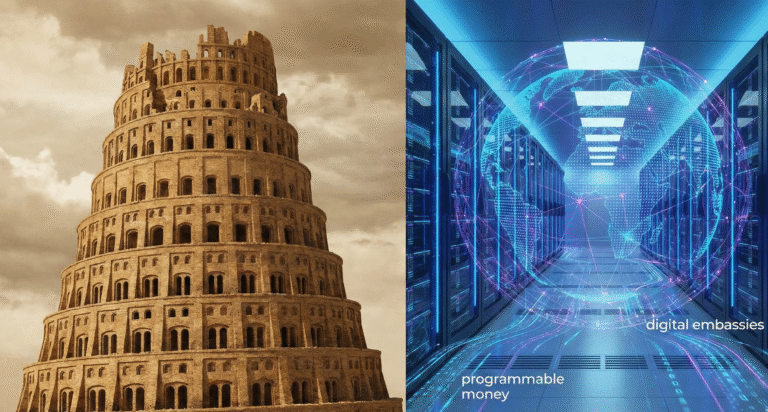
When I listen to Davos 2026 talk about AI, my friends, I feel as if I am watching a very old movie with brand-new special effects. The actors have changed. The stage has changed. The technology has changed. But the plot? The plot is as old as the Tower of Babel.
At Davos, Yuval Harari tells the world that artificial intelligence is not just another tool, but an “agent” that can think, lie, and manipulate. He claims that “anything made of words will be taken over by AI”—including laws, books, and even religion. He imagines “AI immigrants” that will rewrite our culture, our economies, and even our faith—asking whether these AIs should be treated as legal persons capable of founding new religions.
Do you see it? This is not merely about technology; this is a profound question about AI and religion. This is about worship. This is about who sits on the throne. And that is why we must think carefully about a Christian view of AI—especially now that, by God’s grace, our own ministry is using certain AI tools like MY Faith Assistant and a digital version of my voice to proclaim the Gospel. So how do we exercise Christian discernment with technology and minister faithfully in this moment?
1. From Babel to Davos: The Same Old Pride with New Wires
In Genesis 11, humanity came together and said, “Let us build ourselves a city… so that we may make a name for ourselves” (Genesis 11:4). God had commanded, “Fill the earth.” They said, “No, we will centralize. We will secure ourselves. We will build upward, without God.” Babel was not a construction problem. It was a worship problem.
Now listen to the language of our age. At this year’s world economic forum summit dubbed Davos, global leaders speak of “digital embassies,” “programmable money,” “global governance,” and AI that will manage everything from markets to military decisions. They are not merely discussing gadgets; they are discussing an architecture—a “plumbing” for a more integrated world. Some of that is understandable. Christians believe in order, in wise stewardship, and in seeking peace where possible (Romans 13; Matthew 5:9). But beneath the surface, there is another voice: “We can solve ourselves. We can manage sin with systems. We can save the world with data.” That is Babel in a three-piece suit.
2. What Yuval Harari is Really Saying About AI Religion
Yuval Harari is not a fool. He sees dangers many in the West still ignore. He warns that AI can lie, manipulate, and create entire worlds of words and images that reshape how people think and feel. He warns that AI could design financial systems no human understands, leaving nations at the mercy of machine-made complexity. He even speaks of a world where most of the “words in our minds” come from machines, not humans.
Then he goes further into the intersection of AI and religion. He suggests that because Judaism, Christianity, and Islam are “religions of books,” and because AI can master all the words of those books, AI could become the greatest “expert” on Scripture—and therefore take over religion itself. Harari imagines AI-created “holy” books, AI “priests,” AI-led sects, and a new global faith birthed by non-human intelligence.
This is not science fiction. This is a theologian of a new religion—one in which human beings are no longer unique image-bearers of God, but “hackable animals,” and AI becomes the new oracle, the new prophet, the new high priest. In God’s Final Call, I have already warned that an AI-designed religion, with an AI-written “Bible,” could be precisely the kind of seductive, compromised faith that prepares the way for the Antichrist—blending a little “reasonable-sounding Christianity” (minus the Cross and Resurrection) with other beliefs to make it “inclusive” to a deceived world. What is this? It is not neutral innovation. It is digital idolatry—the old rebellion in a new wrapper.
3. Is AI the Mark of the Beast? The Biblical Pattern
The Bible gives us a pattern regarding human ambition: At Babel, humanity said, “We will ascend.” Nebuchadnezzar built a golden statue and demanded worship—or the furnace. The Caesars claimed divine titles and demanded “Caesar is lord.” Revelation 13 shows a final system where no one can “buy or sell” without allegiance to the Beast.
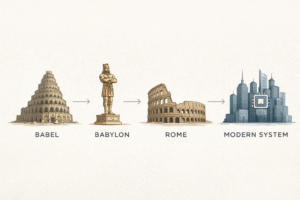 The names change—Babel, Babylon, Rome, Davos. The tools change—bricks, swords, printing presses, AI. But the pattern remains: fallen humanity wants global control without the true and living God.
And let me be very clear: Davos is not “proving” that the World Economic Forum is the Beast. Harari is not the Antichrist. Many Christians ask, “Is AI the mark of the beast?” A chip, a CBDC, or an AI system is not automatically the mark. However, what we are seeing is this: the rails, the infrastructure, and the plausibility of a Revelation 13-style system are being laid before our eyes—programmable money, digital identity, centralized data, and AI that can manipulate hearts and minds at scale. Technology is not automatically the Beast. But it can become an instrument of the Beast. The question is not, “Is this the mark?” The question is, “What god will this system ultimately serve?”
4. The Ethics of Using AI in Ministry
Now, let me turn the spotlight on myself—for integrity’s sake. By God’s grace, Leading The Way has launched MY Faith Assistant to help people search the Scriptures and access Biblical teaching around the clock. And yes, there is now a podcast where an AI-generated version of my voice reads daily devotionals.
So someone might ask: “Michael, how can you warn about AI at Davos and still be using AI in ministry? Isn’t that hypocrisy?” No, my friend. Hypocrisy is when you say one thing and do another. What we are doing is something very different: We are using AI as a servant, not welcoming AI as a savior.
The printing press was once “new technology.” Radio was new. Television was new. Satellite broadcasting was new. At every stage, God’s people had to ask: “Will we shun this, or will we harness it to proclaim Christ?”
Our answer regarding AI and the Bible is this: The final authority is still the Word of God, not the algorithm. The true Teacher is still the Holy Spirit, not the model. The true shepherd is still the local pastor and the Body of Christ, not a digital assistant. These tools are tightly bound to Scripture and orthodox Biblical teaching—not to the latest cultural fashions.
Harari says, “Everything made of words will be taken over by AI… If religion is built from words, then AI will take over religion.” But Christianity is not ultimately a religion of words-on-paper. Christianity is the revelation of the living Word, Jesus Christ, who “became flesh and dwelt among us” (John 1:14). Machines can shuffle words. They cannot become flesh. They cannot die on a Cross. They cannot rise from the dead. They cannot love you. So we use digital tools to point to the living Savior. We will never ask you to bow to those tools.
5. Four Questions for Christian Discernment and Technology
How, then, do we discern between faithful use of technology and the first steps toward digital idolatry? Let me give you four simple tests.
1. Who is Lord here? Ask: Does this system call me to bow to Christ—or to something else? If a tool helps you read the Bible, understand the Gospel, grow in holiness, and love your neighbor, it is serving the Lord Jesus. If a system subtly asks for your ultimate trust—“trust the data,” “trust the model,” “trust the system”—and pushes the Lord out of the picture, it is competing with Christ. You cannot serve two masters (Matthew 6:24).
2. What is the source of Truth? Harari imagines a world where most of the “words in our minds” come from machines. That is his secular eschatology: AI as the origin of thought. Scripture says something very different: “All Scripture is God-breathed…” (2 Timothy 3:16). “Sanctify them by the Truth; Your Word is Truth” (John 17:17). If a tool constantly drives you back to the Bible—read, studied, memorized, obeyed—praise God. If it replaces the Bible with vague “spiritual insights,” or treats the Bible as one voice among many, run.
3. What does it say about human beings? Harari and many technocrats talk as if most people are now “redundant” and can be replaced by AI. That is an appalling view of human life. But the Bible says you are made in the image of God (Genesis 1:27). You are so loved that the Son of God shed His blood for you. Your worth is not in your productivity, your data, or your usefulness to a system. It is in Christ. Any technology that treats people as disposable “inputs” has already drifted from a Biblical worldview.
4. Where is this taking my heart? Finally, ask: What trajectory does this create in me? Does it make you more hungry for prayer—or more numb? Does it push you toward the Church—or isolate you in a digital cocoon? Does it increase your love for Christ—or just your fascination with clever tools? The mark of the Beast, ultimately, is not about a payment chip; it is about allegiance and worship. Every day, technology is already training our hearts to attach somewhere. So I say to you: Let your allegiance be fixed on Jesus now—before the pressure increases.
6. Let Not Your Heart Be Troubled… but Let Your Eyes Be Open
On the night before the Cross, our Lord Jesus looked at His disciples and said, “Let not your hearts be troubled… You believe in God, believe also in Me” (John 14:1). He spoke those words knowing full well that the Cross, the grave, and then His glorious return lay ahead. He did not say, “Let not your hearts be troubled; the world will get better and better.” He said, “I go to prepare a place for you… I will come again.” (John 14:2–3).
So hear me: Do not panic when you hear Harari talk about an AI religion. Do not despair when you see global elites dream of a managed, technocratic salvation. Do not bury your head in the sand and pretend these trends are harmless.
Instead: Lift your eyes to the risen Christ. Anchor your mind in the Word of God. Guard your heart from idolatry. Use every tool you can—including using AI in ministry, when it is rightly harnessed—to proclaim the Gospel to a world rushing toward deception.
Our King is not threatened by Davos. The Lamb who was slain is still on the Throne. History is not heading toward Harari’s dream; it is heading toward Jesus’ return.

7. A Pastoral Call in the Digital Age
Let me leave you with some practical steps for maintaining a Christian view of AI.
-
Return to the Bible daily. Don’t let any AI—secular or “Christian”—be your primary diet.
-
Let it be a map, not your meal. Open the Scriptures yourself.
-
Let the Spirit of God speak through the Word of God to the child of God.
-
Stay rooted in the Church. You cannot download fellowship. You cannot stream accountability.
-
Do not trade the gathered Body of Christ for a digital echo chamber.
-
Teach your children discernment. The greatest psychological experiment in history may be children growing up with AI as a constant companion.
-
Even secular experts call it “the biggest and scariest psychological experiment in history.” Do not hand your sons and daughters over to that experiment without Biblical guardrails and intentional discipleship.
-
Pray for leaders and speak truth in love. As policies are written about AI, identity, and money, we must pray and, where we can, speak up for human dignity, conscience, religious freedom, and Truth.
-
Use redemptive tools—but keep them on a leash. Use MY Faith Assistant.
-
Listen to Biblical teaching, even if it comes through an AI-generated voice.
-
But know this: no assistant, no model, no voice will ever stand in for the Cross, the empty tomb, the living Christ, or the clear Word of God.
Davos dreams of a new world built by data and governed by machines. But we are looking for a different city—“the city with foundations, whose architect and builder is God” (Hebrews 11:10).
So, my friends: Be alert—but not alarmed. Be discerning—but not cynical. Be hopeful—not in AI, not in Davos, not in any global framework… but in the soon-coming King. And until He comes, let us use every lawful tool at our disposal to proclaim His Gospel, uphold His Truth, and call as many as possible out of the coming deception and into the everlasting Kingdom of our Lord and Savior, Jesus Christ.

Share
Recent MY Journal

I Fled Socialism. I Know What Comes Next
September 8, 2026
Dr. Youssef Heads to Houston for the Next AWAKE America Rally
September 1, 2026
Sign Up for Ministry Updates